Wednesday, November 26, 2025
The Truth Series: Fairness in Motion
The portal promises mobility, opportunity, and leverage. But for many athletes, it also brings confusion, conflicting signals, and contract risk in a marketplace moving too fast for clarity. This week, we expose the information gaps that quietly shape athlete outcomes; and show why transparency is becoming the sport’s new competitive and ethical standard.

UpNext
Author
The room goes still.
A name has just flashed across the board. A player this staff has tracked for months. A perfect fit. A priority the moment the window opens. A call goes out. Then another. A third “representative” surfaces, each claiming the same athlete, each certain they’re the one who should be talking.
No one in the room speaks.
Not because anything is wrong.
Because nothing is clear.
By the time the truth sorts itself out, the moment has moved. Another program, less cautious, has already made contact. The athlete never knows any of this happened. To him, one opportunity arrived quickly and another never arrived at all.
This is the part of the portal we rarely acknowledge: opportunity shaped not by talent, but by information asymmetry.
And that imbalance is no longer acceptable.
The Truth the Sport Has Avoided Naming
The portal has been described as chaotic.
But chaos isn’t the enemy.
Opacity is.
The transfer market isn’t unfair because people cheat.
It’s unfair because the truth is unevenly distributed.
Programs suffer inefficiency.
Agencies battle credibility noise.
But athletes absorb the consequences.
You saw the early signals in early episodes of The Truth Series:
- The compression of the January window (Week 1 — The Calm Before the Portal)
- The verification crisis in representation and injury data (Week 2 — The Data Storm)
- The shift toward relevance filtering as the real advantage (Week 3 — The Trust Advantage)
And the data behind those chapters still holds:
- Over 50% of the time programs spent on agent calls last cycle was ultimately viewed as wasted or not legitimate
- Nearly 1 in 4 transfers arrived with an unverified injury record.
Those aren’t operational inconveniences.
They are structural disadvantages, especially for the athletes with the least visibility into how this world actually works.
The Athlete’s Dilemma: Freedom Without Visibility
Publicly, the NIL era is framed as empowerment: more opportunity, more leverage, more mobility.
Privately, for many athletes, it feels different:
“I didn’t know who to trust.”
“I didn’t know which agency to pick.”
“I didn’t know which schools were real options.”
And that feeling has a documented basis.
From Bloomberg Law:
“College athletes have been hit with a wave of questionable business deals, disreputable agents, and outright scams since they gained the freedom to profit off their name, image and likeness.”
The issue isn’t widespread predation.
The issue is pervasive uncertainty.
Athletes face:
- Dozens of agents pitching them
- Long-standing hidden relationships between schools and specific agencies
- Conflicting advice from teammates, staff, and “connectors”
- Low contract literacy in families
- Tight timelines and emotional pressure
None of this is illegal.
Most of it isn’t malicious.
But it creates a marketplace where the most important decision of an athlete’s life happens inside a fog.
Freedom of movement without freedom of information is not fairness.
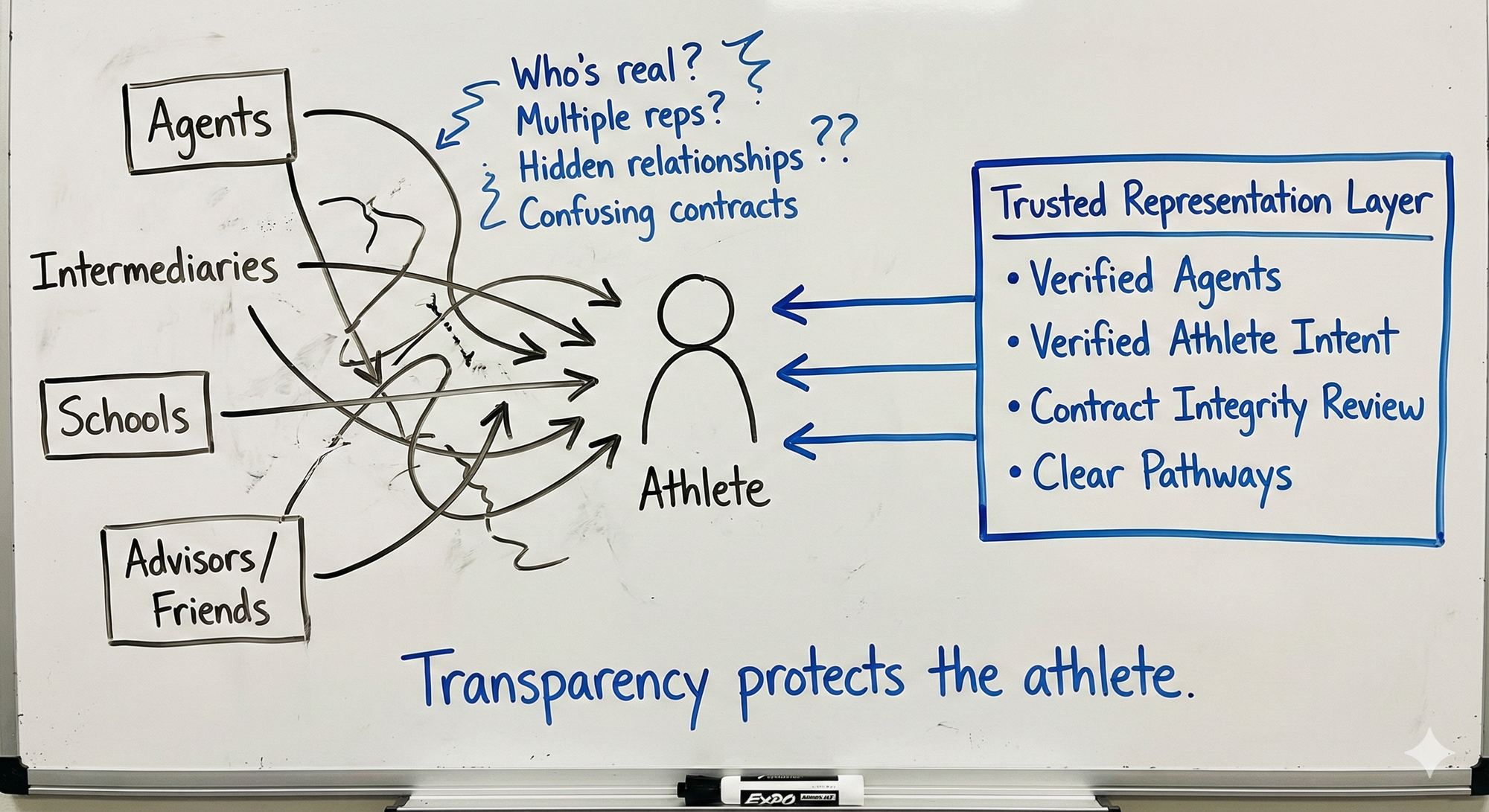
This is the hidden imbalance the sport has lived with for too long.
When Intermediaries Complicate the Truth
It doesn’t happen often, but when it does, it reshapes careers.
- An unaffiliated agent reaches out on behalf of an athlete who never authorized it.
- A family friend “checks interest” without the athlete’s knowledge.
- A local mentor misrepresents a player’s intent to see what bites.
The athlete rarely learns what was said, how it was interpreted, or which opportunities were lost because contact was misdirected.
More commonly, it’s subtler and more pervasive:
It’s simply too hard for athletes to know who is actually working in their best interest.
As Fennemore Law put bluntly:
“Not all NIL agents are equal, and some may not have the necessary experience to represent these student-athletes adequately.”
Experience gaps.
Contract gaps.
Education gaps.
And the athlete is the one navigating it with the least information.
Programs and Agencies Feel the Pain Too. Just Differently.
Programs burn essential early-window hours verifying the basics.
Agencies trying to operate ethically must fight to distinguish themselves from noise.
But inefficiency isn’t symmetrical.
Every hour a staff spends verifying representation is an hour an athlete loses visibility.
Every misroute delays the right conversation.
Every unverified injury note creates hesitation the athlete never sees.
The market today produces unintentional inequity — not through malice, but through misalignment.
As the ABA Journal noted:
“As student-athletes, colleges and private collectives race to sign up star players with promises of lucrative NIL agreements, complexities and potential conflicts abound.”
Complexity isn’t a neutral condition.
It’s a barrier and often an invisible one.
The Contract Layer: The Market’s Blind Spot
Representation isn’t the only place athletes face risk.
Contract literacy is dangerously low.
In the race to sign talent, many deals are:
- Dense
- Binding
- Poorly explained
- Laden with clauses the athlete misunderstands
- Structured to favor the agency more than the individual
UpNext’s work with legal partners has revealed a pattern:
Too many athletes sign contracts they cannot reasonably be expected to understand.
Some commit to multi-year fee structures they didn’t realize were binding.
Some give away marketing rights unintentionally.
Some sign exclusivity clauses that limit future agent options.
Some agree to obligations that conflict with NCAA or team policy.
This is the part of the market that has operated in partial shadow for too long.
Where UpNext Draws the Line
UpNext isn’t just cleaning up contacts.
We’re building the architecture of a fair marketplace.
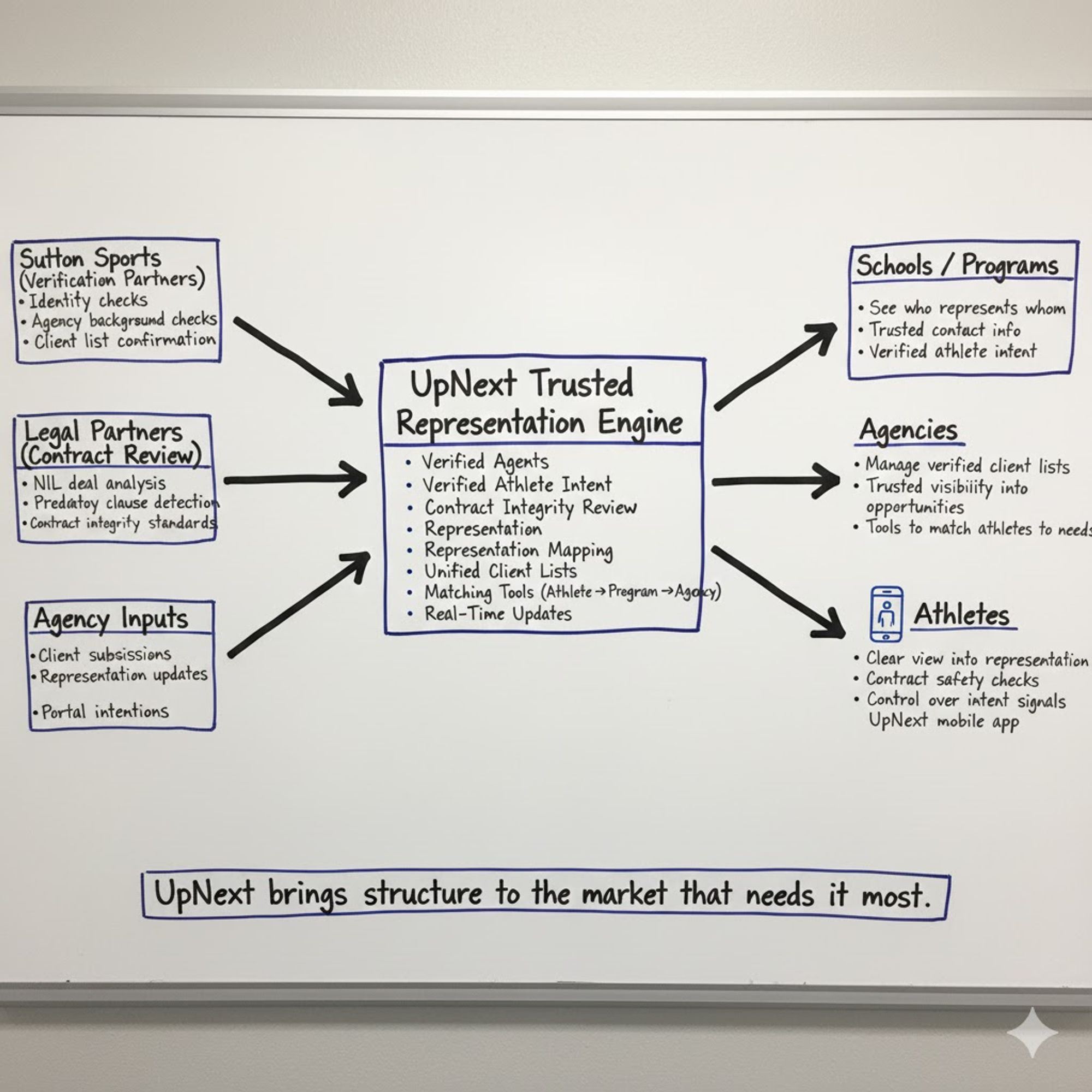
1. Verified Agents & Representation Networks
Real-time confirmation of who represents whom.
Athlete-controlled visibility.
Program-wide certainty.
2. Verified Athlete Intent Signals
No interpretation.
No rumor.
No proxies speaking on behalf of someone who didn’t authorize it.
3. Contract Integrity Standards
This is the new frontier.
In partnership with counsel and trusted industry leaders, UpNext is:
- Reviewing NIL contract templates
- Identifying predatory clauses
- Auditing fee structures
- Collecting anonymized athlete feedback
- Highlighting agencies who uphold ethical standards
- Quietly identifying those who don’t
This isn’t oversight.
It’s illumination.
And the goal is simple:
A marketplace where every athlete can operate safely, informed, and on equal informational footing.
The Human Moment
A veteran agent told us recently:
“If an athlete can’t tell who’s actually helping them, the market has failed before it starts.”
A director of player personnel added:
“We can’t do right by a kid if we can’t tell who we’re talking to.”
Two sides of the ecosystem.
One truth.
Fairness isn’t a feeling.
It’s a system condition.
And system conditions can be changed.
The Cultural Shift
College football is professionalizing in real time.
But the underlying infrastructure hasn’t kept up.
The sport doesn’t need more rules.
It needs more transparency.
Radical, real-time, athlete-first transparency.
Because:
- Coaches can’t offer fairly without truth.
- Agents can’t build trust without clarity.
- Athletes can’t choose wisely without visibility.
The portal can move fast.
But fairness has to move first.
The Truth Line
Speed moves the market.
Transparency protects the athlete.