Wednesday, August 26, 2026
The Season Starts Saturday
Three weeks ago in Nashville, the people who run this market told us what the year ahead runs on. Starting Saturday in Dublin, the season grades their answers.

UpNext
Author
UpNext spent August 3 to 5 at the Personnel & Recruiting Symposium in Nashville. The category read from that trip ran two weeks ago in The Verification Gap. The process piece ran last week in Verify Before You Move. This is the rest of the notebook: the notes that did not belong to either article, published now because every one of them is about to get tested.
Because football is back. Saturday opens in Dublin, of all places, with North Carolina and TCU kicking at noon Eastern, a rematch of last year's 48-14 TCU win in Bill Belichick's college debut. No. 14 USC hosts San Jose State in the afternoon. And the sneaky-good game is the nightcap: Memphis at UNLV at 10pm Eastern, two teams already collecting poll votes, with an early leg up on the Group of Six playoff seat on the line in Week Zero. Eight games, and five of them put a Power Four team on the field.
Rosters rebuilt through the portal are what Nashville spent three days talking about. The games were still weeks out then; the hallway carried the event anyway. Coaches and personnel staff finding old coworkers, three ballrooms running at once while half the building talked shop outside them, around 160 college programs and a couple dozen NFL personnel on the floor. And under all of it, one shared clock: everybody in that building wanted the season to start.
Here is what we wrote down, and what each note means now that the games count.
1. Coaches came to learn how to run a program
The schedule tipped its hand. Building a front office. Structuring student workers and interns. Communicating with decision makers. Managing a budget under marketplace pressure. Evaluation had its lane, film and live evals and background checks, and it was one lane out of many. What coaches came to Nashville to learn was how to build and run a program.
So what: structure is the quietest edge in the sport right now. A front office built in the spring absorbs an October ruling as a Tuesday task. One assembled midseason becomes the story instead of the response.
2. The most-shared advice was about fit
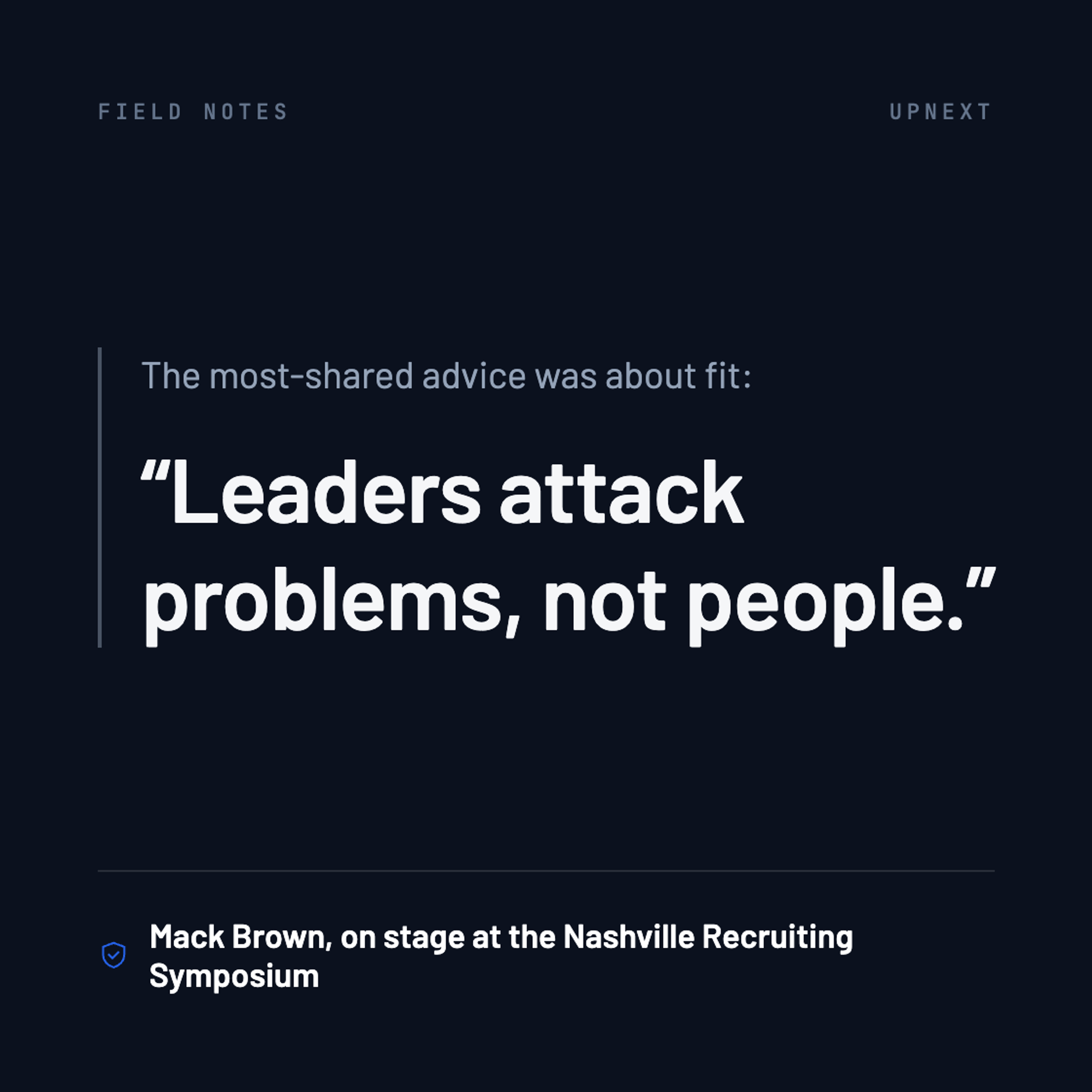
The Mack Brown and Josh Pate conversation was the most passed-around content of the event, and the line that traveled was about recruiting fit over recruiting talent: figure out what a player actually wants. Brown's staff criteria ran the same direction. Happy, energetic, idea-driven, a communicator, an evaluator. "Leaders attack problems, not people." "When people are down, you pick them up."
So what: that sounds like locker room material until you remember what December looks like. A player who got what he actually wanted in the spring is a player still on the roster when the portal opens. Fit is a retention strategy, and retention is the cheapest roster move available. Watch the Week Zero rosters with that in mind: the two-deeps taking the field Saturday are the offseason's fit decisions, graded in public.
3. Describing beats selling, and it starts at home
From the program branding session: "The job is to communicate to recruits what it is like to be here," said Savannah Pate of Victory Rings. The smallest, most honest definition of program marketing anyone offered all week. Her warning ran with it: people can read when you are inauthentic.
So what: the same check runs in both directions, and it runs inward first. A program cannot describe itself honestly to a recruit until it can describe itself honestly to itself: where its players have actually come from, which rooms produced the guys who stayed and played, which portal bets hit and which ones the staff would rather forget. That history is data, and the programs that keep it clean recruit off what has actually worked instead of what the brochure says. An athlete's camp is reading the pitch for authenticity the same way a staff checks a highlight tape against the live eval. The staffs that describe honestly, outward and inward, will out-recruit the staffs that produce harder.
4. Nashville said the market moves in days. Then the last three weeks happened.
The proof point everyone in Nashville carried was the Friday, July 31 federal ruling granting the high school Class of 2022 an extra year of eligibility. Boards moved by Monday. At the time, that felt like the ceiling for how fast this market could change.
It was the floor. Since the symposium ended:
On August 8, the Protect College Sports Act, with the Big Ten and SEC publicly behind it, stalled without a Senate floor vote and Congress recessed. The bill that would cap agent fees at 5%, write agent standards into federal law, and restore the one-time transfer rule now waits on the Senate's September 14 return, which means every program opens the season not knowing which rulebook governs the year.
On August 19, a Louisiana court went further than July did: a temporary restraining order clearing 16 Class of 2022 players, several of them in NFL camps this month, to enter the portal and play a fifth college season. Players in NFL camps last week are portal names this week. One SEC director of player personnel, asked by CBS Sports how staffs are handling it: "You find the person that knows what's going on and you let me know."
And NFL roster cutdowns land August 30. The day after the openers, hundreds of released players become the next wave of the same question.
So what: this is the part of the market the people in that Nashville hallway control least, and they know it. Nobody on a personnel staff gets a vote in a Louisiana courtroom, on the Senate floor, or at an NFL cutdown meeting. Twice in a month a court rewrote the rules of their market from the outside, the only notice anyone got was the news coverage, and the bill that would settle the rulebook went home without a vote. The control a staff does have is smaller, and it is enough: whether its own board is true. Who represents this player now. What his eligibility status is today, under today's ruling. A board built in July has already been rewritten twice, and the season has not kicked off yet. The staffs that treat verification as a standing process spend less of Saturday doing paperwork during the game.
The through line
Every note above is the same note. Know what is actually true, about your board, your players, and your program, before the market makes you prove it. That is what three days in Nashville said. Then three weeks of rulings and recesses said it louder. The season is 14 weeks of finding out who meant it.
UpNext is the verified network for college athletics, where programs, athletes, and agencies operate: 300+ programs, 750+ coaches, 140,000+ athletes, 30+ certified agencies, 70+ conferences, NCAA approved.
Explore the network.
The category read from Nashville runs in The Verification Gap. The four-check process runs in Verify Before You Move.