Wednesday, July 29, 2026
The Short List
Programs cannot always tell who is real. So they run the transfer market through the few agents they trust.


"I meet and talk to a different 'agent' that I've never heard of every day that's supposedly representing some player that I heard yesterday that another agency is representing."
A GM's phone rings. The caller says he represents a running back in the portal. Yesterday a different caller claimed the same player. Both sound real. One is.
The line at the top belongs to a coach. Coaches say it to Cody Cater so often he calls it their famous quote. Cater is UpNext's COO. He played safety at Wake Forest from 2020 to 2024, through the first NIL deals and the portal's biggest growth years, and now sits on calls with programs and agencies nearly every day, across the 300+ programs and 30+ certified agencies that operate on the network. This piece is what hundreds of those conversations say about how the transfer market actually clears.
What this means
- Money sets the market. Knowing who actually holds the relationship is what clears it.
- Programs are already solving that by hand: a short list of one to three trusted agencies, and a staff-room whiteboard that decides who gets a call back.
- For an agency, the cost of staying off the list is silence. The call never comes.
The money decides, and it never stops deciding
The cap now runs the roster. "It's all about that cap and managing spend," Cater says of his P4 conversations. "What a roster is made of, what players are playing, which ones get recruited versus not." And the market never closes. Programs are calling agencies for their January portal lists before camp opens. "It just keeps getting earlier and earlier on," he says. A year-round market with real money in it has to know who it is talking to.
Anybody can be an agent tomorrow
College football has no equivalent of the NFL's agent certification. "It's very different than your NFLPA, where there's certified agencies that everyone knows," Cater says. In the college space, he says, "anybody can be an agent, represent any player tomorrow, or claim to represent said player and end up talking to the general manager at any program."
The program cannot tell the real caller from the rest, so it protects itself the only way it can. "A program will kind of put up its walls because they don't know what's true," Cater says. "Maybe it's actually legit. But ... they really won't open up and talk ball." The wall costs both sides. The honest agent absorbs the suspicion earned by the fakes, and the program goes quiet on players it should be recruiting. The established agencies feel it too: "They have other folks calling coaches, claiming they represent their guys."
The short list
Ask a GM whether he picks up the phone for an agent and, Cater says, "they always immediately roll their eyes." What programs do instead has quietly changed. "A given program will pick one to three agencies or agents that they trust," he says, and route the conversations that matter through them, instead of "the five to one conversations that they had to deal with so far." Some staffs go further and keep "a list on the whiteboards in staff rooms of good and bad agencies for everyone in the program to follow."
That is a market inventing verification by hand. Whiteboard by whiteboard.
Why it compounds
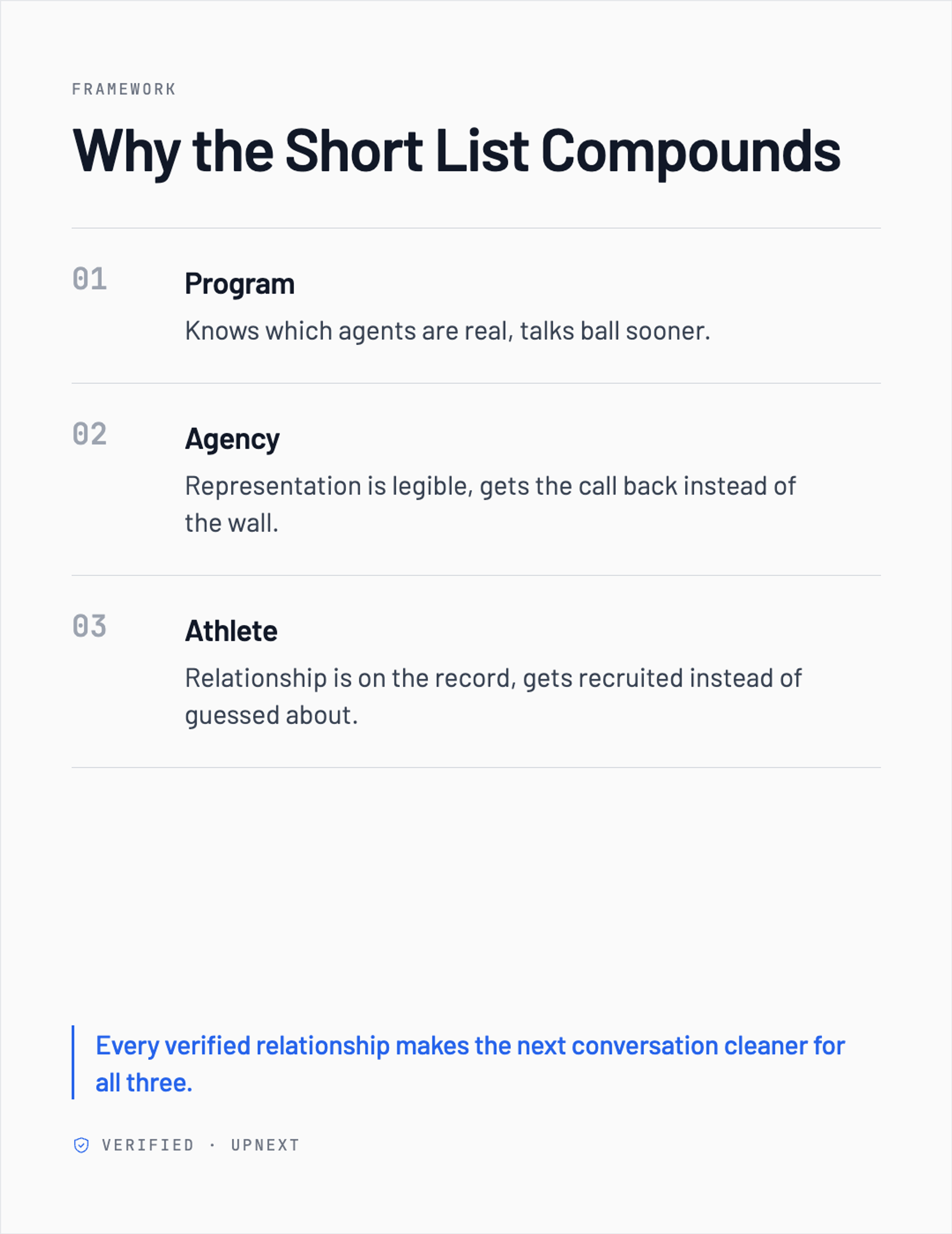
The short list works because each side makes it work for the other two. A program that knows which agents are real talks ball sooner. An agent whose representation is legible gets the call back instead of the wall. An athlete whose relationship is on the record gets recruited instead of guessed about. Every verified relationship makes the next conversation cleaner for all three.
On UpNext, that instinct runs at market scale, and the manual labor comes off the staff. Every agency is vetted and certified before it earns a verified profile, and the profile ties each agent to the athletes they actually represent. The checking, the calling around, the list-keeping: that work becomes a lookup. Verification makes the relationship legible in seconds. It does not close a deal for anyone; it starts the right conversation directly and early.
Proof
The verified network today: 30+ certified agencies, 300+ programs, 750+ coaches, 140,000+ athletes, 70+ conferences. The demand is in the operators' own words. Staffs, Cater says, "will just task those one to three agencies [they trust] with going and getting a player that they like." The trusted call is the one that happens.

FAQ
How does an agency get on a program's short list? The way trust is always built. Deals that closed clean, claims that held up, "the ones that they trust and like," in Cater's words. Verification earns the first look; the work earns the relationship.
Doesn't a short list cost the program options? It trades a wide market for a real one. Fewer conversations, and every one of them is real. GMs are making that trade on purpose.
What does verified mean on UpNext? An agency is vetted and certified before it earns a verified profile, and the profile ties each agent to the athletes they actually represent. It makes representation legible. The football judgment stays yours.
Where this lands
A GM should not need a whiteboard in the staff room to know who represents a player. On the UpNext verified network, he doesn't.