Wednesday, September 23, 2026
The second January
Twenty-nine programs hired a head coach for 2025. Twenty-five of those coaches are still in the chair, and each one just ran his second portal cycle with a year of film on his own decisions. The people behind the counts include a Division II MVP starting at Bowling Green, a Springfield quarterback who came home to a 0-12 UMass, and a Richmond linebacker who got a call from Bill Belichick. Five programs, 272 recorded transfers.

UpNext
Author
Jay Kastantin threw 24 completions in 30 attempts for 262 yards in his first FBS game. A year earlier he was the conference MVP at Assumption, a Division II program in Worcester, Massachusetts, where he threw for 1,974 yards and ran for 530 more. In January he completed a transfer to Bowling Green, spent August beating out a quarterback who came from Oregon for the job, and on September 5 made his debut against Tarleton State. Bowling Green lost 20-13.
That is the second portal cycle in one person. A staff that had a season of film on its own roster went looking for what it was missing, found a starter two levels down, and gave him the job over a Power Four transfer. It also lost 14 players to Power Four programs in the same window. Both of those things are true at once, which is what makes year two worth reading.
Twenty-nine programs hired a head coach for the 2025 season. Four of those coaches have already moved on or been replaced, so 25 second-year staffs went through the 2026/27 cycle. Every one of the 25 recorded between 24 and 84 completed transfers, in and out combined. A first-year staff gets one cycle to make the roster its own, and that cycle draws the coverage. The second one comes with a season of film the first did not have. By the second January a coach has a season of film on the players he brought in, a season of film on the players he inherited, and a clearer idea of what the room is missing. What he does with that window is a decision about how much of year one he wants to keep.
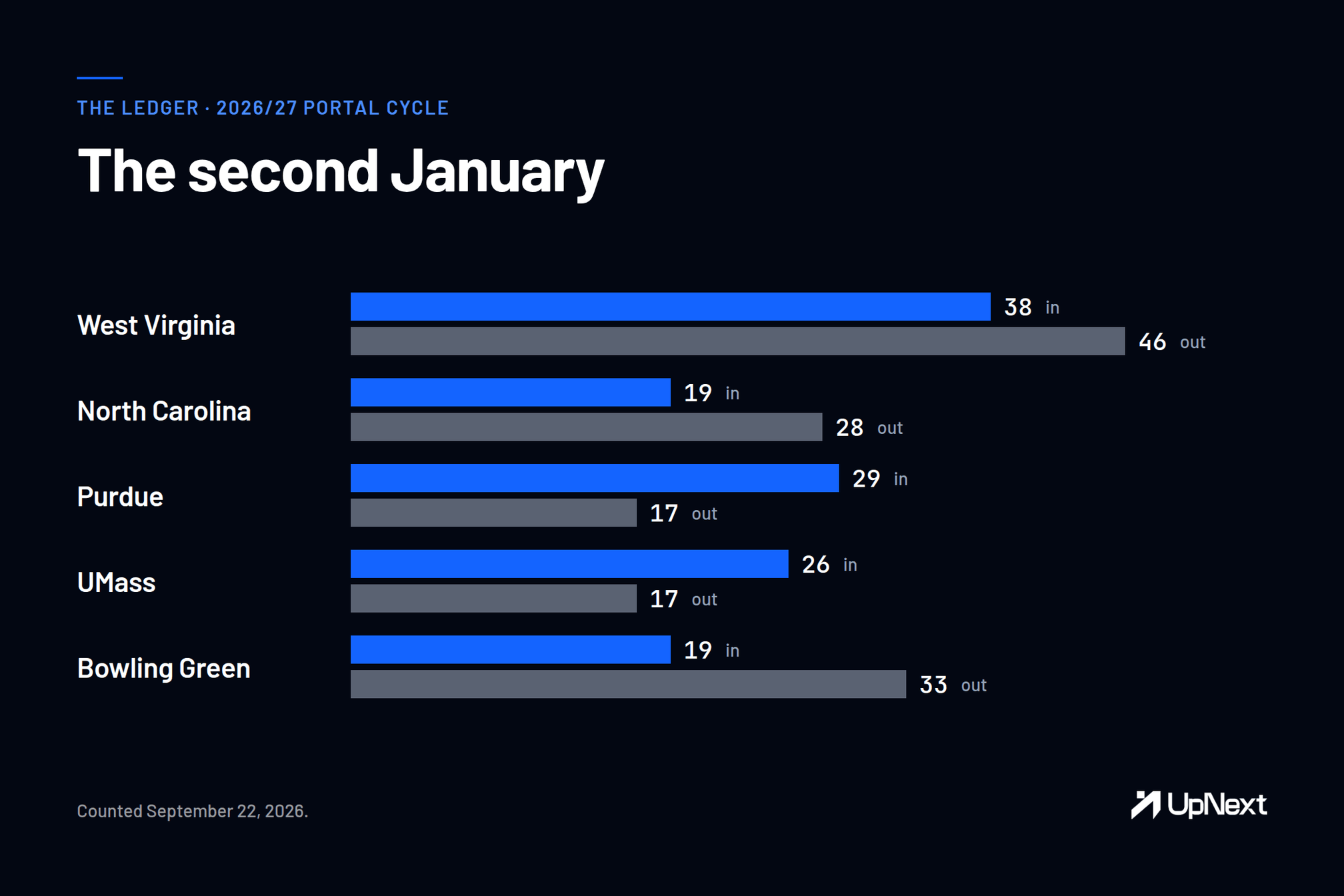
This piece takes five of the 25, each at a different point in the rebuild: West Virginia, North Carolina, Purdue, UMass and Bowling Green. Together they recorded 272 transfers, 131 in and 141 out. The counts come from each program's transfer record for the current cycle; the method is at the bottom. The first-cycle context comes from the public record, because the numbers reported at the time are the numbers those staffs were working with. Every row is two decisions read from opposite chairs: a coach deciding how much of his first class to keep and where to shop for the rest, and a player deciding whether a staff that has shown its hand for a season is one to join or one to leave with a year of film in hand. Under each count is at least one person most readers will not have heard of, and the decision he made.
West Virginia: 38 in, 46 out
Subscribers: open West Virginia's team page.
Shane Cornali played outside linebacker and receiver at Fort Cherry High School, about an hour north of Morgantown, and won two WPIAL titles there. In 2025 he redshirted at Wheeling University, a Division II program in the Mountain East Conference. On January 30, 2026, the record shows him completing a transfer to West Virginia, where he is converting to safety. He was one of 32 arrivals the record dates to that day.
Thirty-two transfers the record dates to one day is the shape of Rich Rodriguez's second cycle. West Virginia hired him on December 12, 2024, from Jacksonville State, and his first season went 4-8, 2-7 in the Big 12. The first cycle was a full rebuild; public reporting in April 2025 counted more than 30 portal entries after spring roster cuts alone. The second cycle was almost as large. Forty-six players left and 38 arrived, 84 recorded transfers in one cycle.
The 46 departures went everywhere. Ten to other Power Four programs, among them Penn State, Wisconsin, Tennessee, Arkansas and Miami. Twenty-four to the Group of Six, four of them to Marshall and three to South Florida. Ten to FCS programs and two to NAIA or junior college. Seven linebackers, seven receivers and six offensive linemen. The 38 arrivals came from 13 Power Four rooms, 20 Group of Six rooms, three FCS programs and two Division II programs, Wheeling among them. Three arrived from Jacksonville State, Rodriguez's previous program.
Two of the 13 Power Four arrivals are brothers. Michael Hawkins Jr. started seven games at quarterback for Oklahoma across 2024 and 2025 and entered the portal on December 31. His brother Maliek, a defensive back, committed to West Virginia the same day he did. On Saturday in Charlotte, Michael accounted for all five West Virginia touchdowns, two throwing and three running, and ran for 123 yards in a 38-27 win over Virginia. Virginia, which appeared in this space a week ago, came in ranked 25th. West Virginia is 3-0 for the first time since 2018.
Rodriguez described the difference between the two cycles himself. "A year ago, it was everything," he said in March. "This year, we intentionally took a lot more high school guys. We don't have 40-some seniors who are one-and-done." The record supports that: 38 arrivals against 46 departures is a roster that got smaller through the portal, and public reporting in March put returning players at 31 and returning starters at six. From the player's chair, a room where the record dates 32 arrivals to the same day is a room where nearly everyone is new at once, which removes one of the usual disadvantages of transferring. No returning player holds a two-year head start on the newcomers, whether the newcomer is a redshirt from Wheeling or a quarterback from Oklahoma.
Beating a ranked Virginia team in the third game is one result, and a good one for a program that went 4-8. Nine Big 12 games remain, starting with Oklahoma State on Saturday.
North Carolina: 19 in, 28 out
Subscribers: open North Carolina's team page.
Peyton Seelmann led Richmond in tackles in 2025 with 120, second in the Patriot League and eighth in FCS. He had 20 in one game against Bucknell, the most by a Richmond player since 2019. He entered the portal in December, and by his account North Carolina's staff called within the first day or two. He visited on January 6 and committed. "He saw me in a lot of ways," Seelmann said of Bill Belichick in August. "He's a really good dude, and he's really personal." The record shows his transfer completing on January 14, the same day as a Richmond defensive lineman, Donovan Hoilette.
North Carolina hired Belichick on December 11, 2024. The first cycle drew coverage all year: public reporting counted 71 new players on the 2025 roster, 41 of them transfers. The team went 4-8, 2-6 in the ACC. The second cycle was smaller. Nineteen arrivals, 15 of them from Power Four rooms, two each from LSU and Wisconsin. Three from FCS programs, two of them from Richmond, and one from the Group of Six. Eighteen of the 19 are dated in January. Four offensive linemen, three tight ends, two linebackers and two quarterbacks.
Twenty-eight left. Twelve went to Power Four programs, with N.C. State and Boston College taking two each. Eleven went to the Group of Six, two of them to Charlotte. Three went to FCS and two to Division II or junior college. Six receivers, five defensive linemen and four offensive linemen.
One of the two quarterbacks who arrived is Billy Edwards Jr., from Wisconsin, in his sixth college season. He is the starter. North Carolina is 2-1: a 15-10 win over TCU in Dublin, a 35-3 win over East Tennessee State, and a 28-20 loss at Clemson on Saturday in which the Tar Heels led 20-15 with 8:11 to play before a lightning delay of two hours and 28 minutes. Clemson scored 13 straight after the restart.
Read the two columns together and the second cycle at North Carolina looks like a staff that had already done its sorting. The first year replaced most of the roster. The second year took 19 players, 15 of them from rooms at the same level, and let 28 go, 12 to programs at the same level and 16 to programs a level or more down. For the players who left for N.C. State, Oregon or Auburn, a year in a rebuilt Power Four room produced film another Power Four room wanted. For Seelmann, a roster that had turned over 71 players a year earlier was a place where a Patriot League linebacker could get a call on day one and a depth chart that was still open.
Purdue: 29 in, 17 out
Subscribers: open Purdue's team page.
Travis Terrell Jr. ran for 607 yards and five touchdowns at Jackson State in 2025 and returned kickoffs, and the year before that he brought two kickoffs back for scores. He is five-foot-nine. He committed to Purdue in January and said the move "wasn't an emotional or feeling based decision. This was a personal/business decision for me, and my family, and my future." By the end of fall camp, Barry Odom was calling him an every-down back. He is the second back and the kick returner on a Big Ten roster that went 0-9 in the league last year.
Odom's first season at Purdue went 2-10. Public reporting counted 82 new players on that roster. In January, Odom said the staff was "trying to be a little more selective and direct" the second time through. The record shows what that looked like: 29 arrivals, 25 of them dated January 22, and 18 of the 29 from Power Four rooms, two each from South Carolina, USC, Illinois and UCF. Four came from the Group of Six, four from FCS programs, Jackson State among them, one from junior college, and two carry no recorded origin. Six defensive backs, five receivers, five offensive linemen and three defensive linemen.
Seventeen left: 10 to Power Four programs, Minnesota and Pittsburgh taking two each, six to the Group of Six, and one to Division III.
Purdue's two leading receivers on Saturday were January arrivals. Xavier Townsend, whose transfer from Iowa State the record dates to January 22, caught six passes for 162 yards and two touchdowns at UCLA, one of them a 75-yard crossing route the program noted as the longest scoring play of Odom's tenure. Asaad Waseem, from Florida Atlantic and dated the same day, caught eight for 149. Purdue lost 52-38 and is 1-2, with a 44-19 win over Indiana State and a 38-36 double-overtime loss to Wake Forest. A 2-10 team losing at UCLA by two touchdowns is about what the level and the venue would suggest. The double-overtime loss to Wake Forest at home is the result that sits outside that expectation.
From the staff's chair, 18 Power Four arrivals in a second cycle is a decision to fill the room with players who have already practiced against Big Ten and SEC depth charts, which is what Odom's "selective and direct" looked like in the record. From the player's chair, Purdue in January 2026 was a Big Ten program coming off 0-9 in the league, which is another way of saying a place where a receiver from Iowa State, a receiver from Florida Atlantic, or a back from Jackson State could expect to play in September. All three did.
UMass: 26 in, 17 out
Subscribers: open UMass's team page.
William Watson III grew up in Springfield, Massachusetts, 25 miles from the UMass campus, and was the state's Gatorade Player of the Year in 2022. He went to Virginia Tech and started two games in three seasons. He entered the portal on December 26 and committed to UMass on January 11, to a program that had just gone 0-12 and lost those 12 games by an average of 39-11. In his first start, on September 3 at Rutgers, he completed 19 of 22 passes for 197 yards and three touchdowns. UMass won 37-21. It was the program's first win over a Power Four opponent since 1978 and the end of a 16-game losing streak.
UMass hired Joe Harasymiak on December 4, 2024, from the Rutgers defensive coordinator job, and the first cycle brought in 29 transfers by public count. The second cycle added nine more players than it lost. Twenty-six arrived: eight from Power Four rooms, two of them from Indiana; five from the Group of Six; nine from FCS programs, two of them from William & Mary; and four from Division II, Division III or NAIA. Twenty-one of the 26 are dated in February. Seven defensive linemen, five linebackers, four offensive linemen and three backs.
Seventeen left: four to Power Four programs, three to the Group of Six, nine to FCS and one to Division II. Six of the 17 were defensive linemen and four were quarterbacks.
Nine FCS arrivals is the number that shapes UMass's cycle. A staff coming off 0-12 took eight players from Power Four rooms and nine from FCS, and the FCS group was the one that had started where it came from: a lineman from William & Mary, a defensive lineman from Albany, a back from Murray State. For those players, a MAC program that had lost 16 straight had open snaps across the depth chart. Harasymiak said in September that the program had needed a quarterback "bad," and that with what he has been promised, "we're able to be at the group of six level."
UMass is 3-0 after beating Sacred Heart 37-10 and Stonehill 36-14, its first 3-0 start since 2007. Sacred Heart and Stonehill are FCS programs, so the Rutgers game is the one that changed the season's expectation. It was won at the school Harasymiak left to take the job, by a quarterback who had thrown 63 passes in three years somewhere else.
Bowling Green: 19 in, 33 out
Subscribers: open Bowling Green's team page.
Nate Pabst started 38 consecutive games for Bowling Green over three seasons, all 12 of them in 2025 as a captain, and played both guard spots and both tackle spots along the way. He is six-foot-three and 315 pounds, with one season of eligibility left. On January 26 the record shows his transfer completing to Florida State. He is one of 14.
Eddie George's first season at Bowling Green went 4-8, 2-6 in the MAC, and public reporting counted 30 players out and 30 in during that first cycle. The second cycle sent Bowling Green's players up. Thirty-three left, and 14 of them went to Power Four programs, more than any of the other 24 second-year programs. Northwestern and Iowa State took two each; the other 10 went one apiece to programs in all four Power Four leagues, Ohio State, Wisconsin, Auburn and Florida State among them. Five went to other Group of Six programs, nine to FCS and five to Division II or Division III. Twenty-four of the 33 are dated in January. Six receivers, five backs, four linebackers and four corners.
Nineteen arrived: three from Power Four rooms, six from the Group of Six, seven from FCS programs and three from Division II or Division III. Kastantin is one of the three. Austin Novosad, the quarterback he beat out in August, is one of the three from Power Four rooms; he came from Oregon.
That is the shape of the column. A Group of Six starter with three years of film and a year left moves to a Power Four program that wants the experience, and the staff replaces him with someone from a level or two down who has film of his own. Pabst left for Florida State with 38 straight starts behind him. Kastantin arrived from Assumption with a conference MVP season and threw for 262 yards in his first FBS game. The column records both moves and neither reason.
Bowling Green is 0-3, with the 20-13 loss to Tarleton State, an FCS program, and losses of 56-7 at Nebraska and 55-7 at Iowa State. The two road results are what a MAC roster that lost 14 players to Power Four programs would be expected to get in those buildings. The Tarleton State result is the one that sits outside what the level would suggest. George said in September that "the expectation level is to get better." The record shows a second-year staff that kept players other programs wanted for a year and then had to replace them, which is a condition of the job at that level and a cost the staff carries through the season.
What a second cycle shows
The five have little in common on the field. Two are Power Four programs coming off 4-8, one is a Power Four program coming off 2-10, and two are MAC programs coming off 4-8 and 0-12. What they share is a coach in his second January with a season of film on his own decisions, and five different answers to what to do with it.
Each row is still a person's decision, and most of the people are not famous. They include a redshirt from a Division II program an hour up the road, a Patriot League linebacker who got a call on day one, a Jackson State back who called it a business decision, a Springfield quarterback who came home to a 0-12 team, and a Bowling Green captain with 38 straight starts and one season left. Neither the coach's reasoning nor the player's is in the record. The count is, and the record next to it: 3-0, 2-1, 1-2, 3-0 and 0-3, each read against what the program's level and last season would lead you to expect.
The third cycle starts when the window opens.
Counted September 22, 2026, for the 2026/27 cycle. Explore the network.
How we count. The 29 programs are the FBS programs that hired a head coach for the 2025 season, per public coaching-change records; the 25 are those whose 2025 hire is the head coach in 2026. The five featured programs were selected from the 25 by reading each program's completed transfers in and out and choosing five with distinct patterns. Arrivals and departures are the transfers recorded in the network's Transfer activity record for each program for the current cycle, the same record behind each team page's Transfer activity tab, read in full on September 22, 2026. Each team page lists the recorded transfers in and out with the athlete's position, the origin or destination program and its conference; the full list loads as you scroll. Rows dated August 1, 2026, the date of an NCAA bulk event that re-dated prior movements, are excluded from every count in this piece. One departure row recorded against a program the athlete had already left (a Purdue linebacker's later move) was removed. An arrival with no recorded origin counts as an arrival at the destination program and is not counted as a departure from any program. Level groupings follow each origin or destination program's football conference: Power Four, Group of Six, FCS, and Division II, Division III, NAIA and junior college together; independents are grouped with the level they compete at, and one conference label in the record (North Dakota State) was corrected to its FCS conference. Positions as listed on each athlete's UpNext profile. Athlete backstories and first-cycle figures are from public reporting and are labelled as such. Game results and rankings as of September 22, 2026.