Thursday, November 5, 2026
The Operators Have Seen the CSC's Numbers. They Aren't Using Them.
The people who build rosters read the College Sports Commission's numbers last week, checked them against the deals on their desks, and went back to work.

David Antoline
Author
On October 30, the College Sports Commission published its first compensation report: data on what college athletes were paid in revenue share from their schools and in third-party NIL deals the CSC cleared, broken down by sport, position and conference.
Since then, you have probably heard it called a step forward for transparency in college sports. The people who use compensation data for a living have come to a different conclusion.
Take that data at face value and build a Power Four football roster from it, slot by slot. It costs $15.8 million. Do the same for an SEC basketball roster and it costs $1.5 million, with the sixth man at $83,000 and the last six players at nothing. Public reporting puts both far higher. The CSC's arithmetic holds up; its data counts only the part of each deal that passed through the CSC.
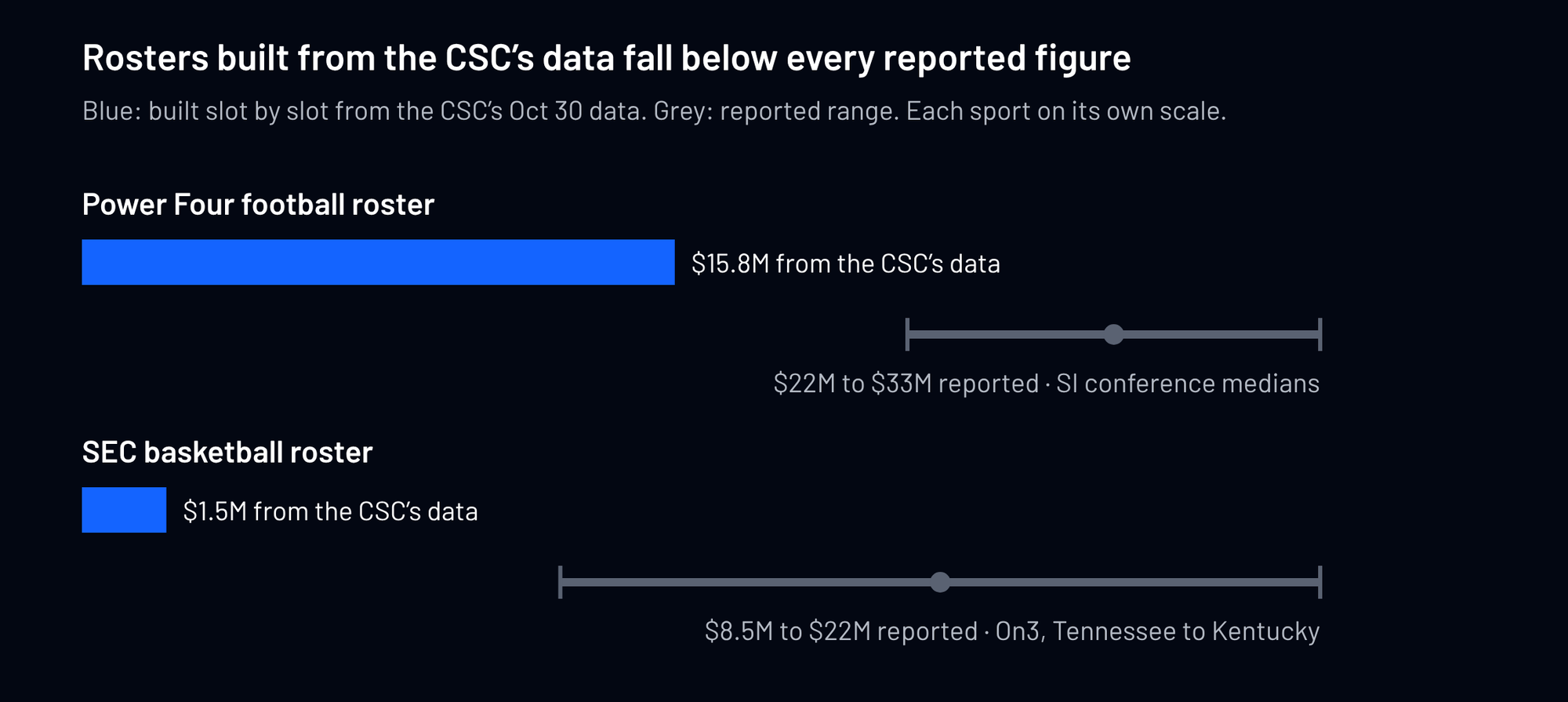
Roster built by UpNext slot by slot from the CSC's Oct 30, 2026 compensation data, each slot read by rank from the CSC's percentiles. Reported: Sports Illustrated, Aug 2026 (Power Four conference medians); On3, 2025-26 (SEC rosters priced, Tennessee to Kentucky).
In the second week of December, a general manager at a Power Four program will have an agent on the phone about a redshirt-sophomore edge rusher: three years of eligibility, eleven starts in a Group of Six scheme that has sent two linemen to the NFL, asking $900,000 for one season. On the GM's screen will be the CSC's report, forwarded by someone in the building with a note that begins, "Coach, why aren't we using the numbers the CSC provided us?"
The CSC's data says the median revenue-share payment to a paid Power Four defensive lineman is $150,000 and the median cleared NIL total is $26,500. The GM knows better, because he priced four of these players last winter. The agent knows better too. The people who do not know better are the ones the numbers will hurt, starting with the edge rusher's parents, who will see the $150,000 median in a headline, or hear it from the school, and wonder what their son's agent is doing.
The CSC's chief executive, Bryan Seeley, described the October 30 release as "the first time compensation data of this kind has been published for college sports," issued "to help people make better informed decisions while preserving the confidentiality of individual agreements."
Since the release, the general managers, personnel directors and agents on our network have told us the same thing in nearly the same words: the data describes a market they do not recognize, and they are not pricing from it.
The release invites readers to take the CSC's count as something more: a regulator's read on what athletes are worth, the kind of number a players' association gives its members. On that December call, the general manager and the agent will set the price. The player and his parents will hear the CSC's numbers anyway, in headlines and from the school, as though they were the market. They are the ones least able to tell the difference.
Disclosure. The author is Chief Operating Officer of UpNext, which builds roster and representation tools for college programs and agencies. Every CSC figure here was taken from its public pages on October 30 and 31, 2026.